By overturning CAF’s decision to award Morocco the 2025 AFCON title, the Court of Arbitration for Sport has reinforced a fundamental principle of football: sporting outcomes must be respected, even when disciplinary issues arise.
Football has rules, referees, and disciplinary committees. But its most fundamental principle remains unchanged: matches are won on the pitch, not in boardrooms.
The Court of Arbitration for Sport (CAS) has delivered a timely reminder of that principle by overturning the Confederation of African Football (CAF) Appeal Board’s decision to award Morocco the 2025 Africa Cup of Nations title following Senegal’s temporary walk-off during the final.
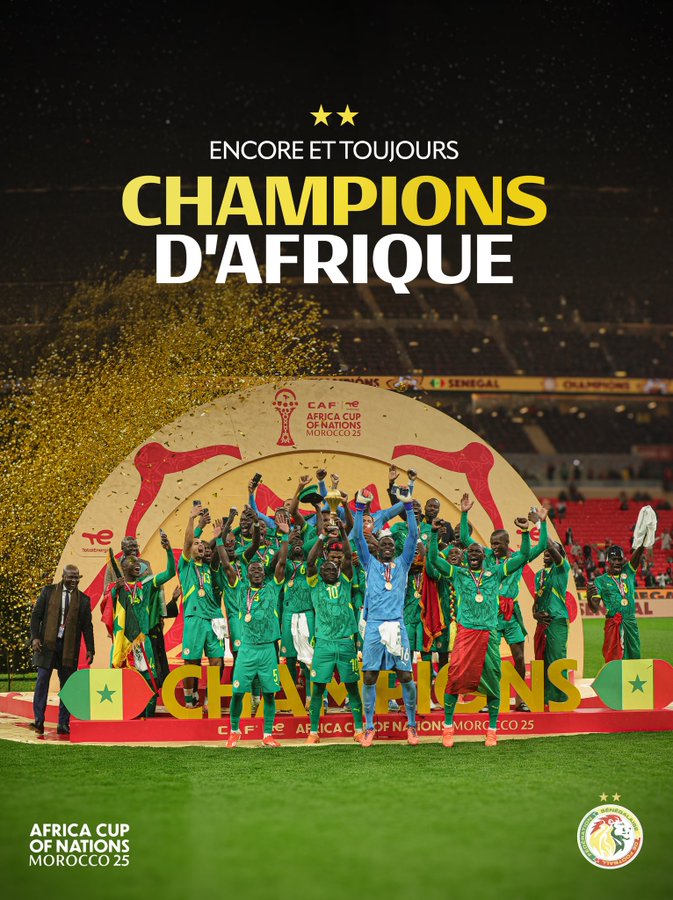
In a unanimous decision announced on Tuesday, 24 November 2026, CAS upheld Senegal’s appeal, reinstated the CAF Disciplinary Board’s original decision, and confirmed the result of the final: a 1-0 victory for Senegal.
Beyond restoring Senegal’s championship, the verdict carries significant implications for the governance of football, particularly the authority of referees and the limits of disciplinary intervention.
At the heart of the decision was a simple question: who has the authority to decide whether a football match continues or ends?
Senegal’s players had temporarily left the pitch during a highly charged final, prompting controversy over whether their conduct breached Articles 82 and 84 of the AFCON Regulations.
Morocco’s football federation argued that the referee, Jean-Jacques Ngambo Ndala, should have ended the match and that Senegal’s conduct warranted forfeiture.
However, CAS ruled that the decision to resume or stop the match fell within the referee’s sole authority.
By restarting play at the 109th minute (90+19), after both teams had returned to the pitch and expressed their willingness to continue, the referee had determined that the conditions for resumption had been met.
The panel concluded that this decision was protected by the ‘field of play’ doctrine and could not be overturned through the disciplinary interpretation advanced by Morocco.
This is where the verdict becomes particularly important.
The field of play doctrine protects decisions made by match officials during a game from being routinely revisited by external authorities. It recognises that referees must make difficult decisions in real time, often under extraordinary pressure.
If every controversial decision could be reopened after a match, the authority of referees would become increasingly vulnerable to administrative interference.
CAS has reinforced the distinction between punishing misconduct and changing the outcome of a match.
Importantly, the verdict does not absolve Senegal of responsibility for its conduct. The panel acknowledged that the Senegalese Football Federation, coach Pape Thiaw, and some players had already been sanctioned by CAF through separate disciplinary proceedings.
But those sanctions did not justify overturning the sporting result.
CAS determined that Articles 82 and 84 were intended to establish the outcome when a team’s conduct causes a referee to abandon a match permanently. In this instance, the referee had restarted the game and allowed it to reach its conclusion.
The distinction is fundamental. A team can be punished for misconduct without automatically forfeiting a match that has subsequently been completed under the referee’s authority.
Had Morocco’s argument prevailed, it could have created a troubling precedent in which disciplinary proceedings became an avenue for retrospectively changing sporting outcomes, even after a referee had decided to continue a match.
That would introduce uncertainty into football and potentially undermine the credibility of competitions.
Morocco was entitled to challenge CAF’s initial decision, just as Senegal was entitled to seek redress before CAS. But the right to challenge a decision does not necessarily mean the right to have a result overturned.
The verdict also leaves CAF with important questions to address. Its Disciplinary Board and Appeal Board reached different conclusions, with the latter’s decision now overturned by the international arbitration body.
Consistency in interpreting competition regulations is essential if African football is to strengthen confidence in its institutions.
The referee’s decision was made in an atmosphere of extreme tension. CAS acknowledged the circumstances but found no evidence that his judgment had been influenced by external factors. It, therefore, rejected the description of his decision as arbitrary.
Ultimately, Senegal’s 1-0 victory has been restored, ending the uncertainty over who won the 2025 AFCON final.
This is not a declaration that referees are beyond scrutiny or that teams should escape punishment for abandoning the pitch. Rather, it is a reminder that sporting justice and disciplinary justice must operate within their proper boundaries.
Football’s integrity depends on rules being applied consistently, referees being allowed to exercise their authority, and results being respected.
The final whistle must mean something.
And that is why the CAS verdict matters beyond Senegal and Morocco. It protects a principle that should remain central to the beautiful game: football matches are decided on the pitch, while disciplinary bodies ensure that the rules are respected.